20 Amazing Facts About Animals That Sound Too Strange to Be True
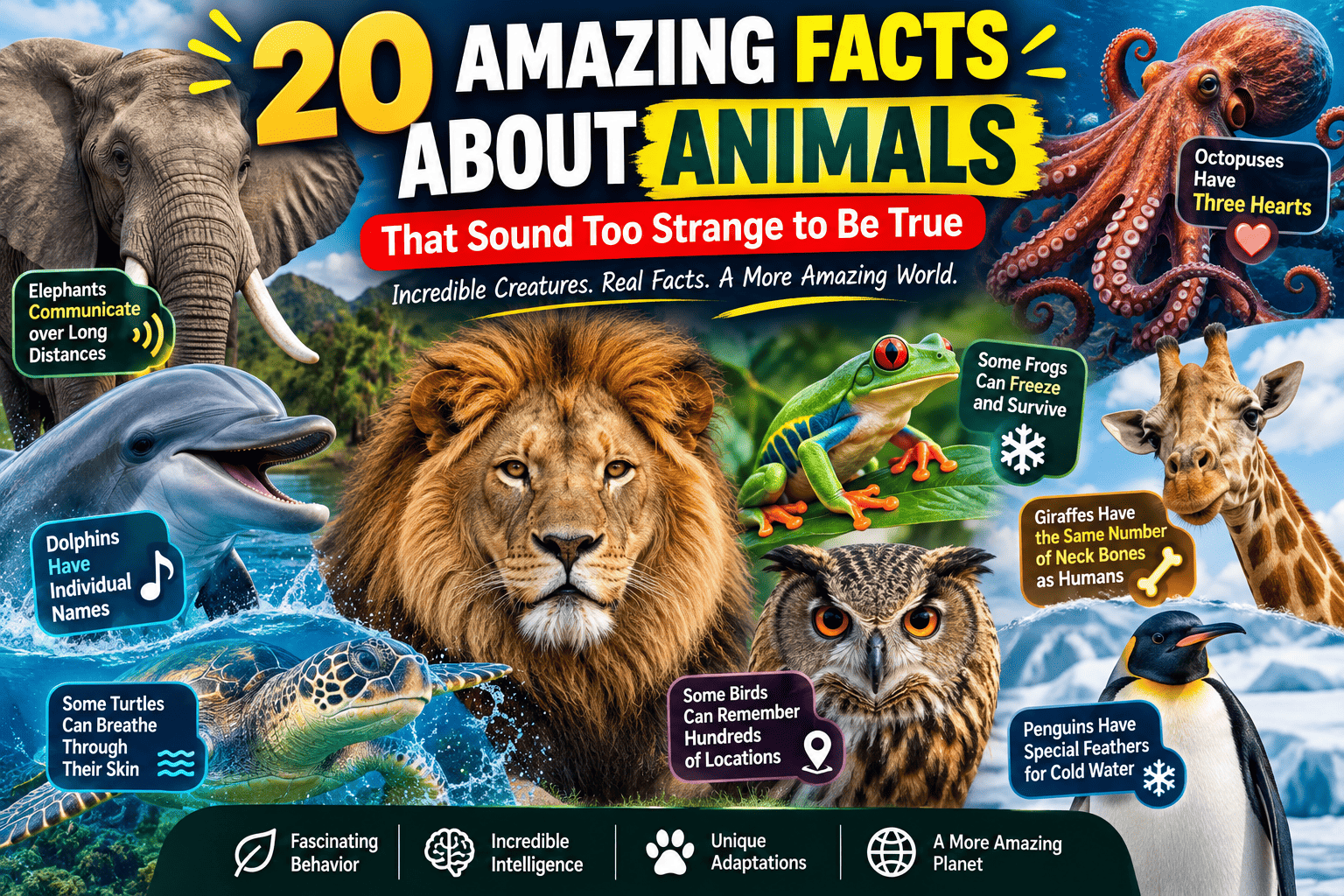
9. Penguins Have Specialized Feathers for Cold Water
Penguins spend a significant amount of time in cold environments and underwater.
Their feathers are densely packed and provide insulation, while their bodies are adapted to conserve heat.
Penguins also have layers of body fat that provide additional insulation.
These adaptations allow them to function in environments that would be extremely challenging for many other animals.
10. Giraffes Have Extremely Long Necks
The giraffe’s long neck is one of the most recognizable features in the animal kingdom.
Despite the length of its neck, the giraffe has only seven cervical vertebrae—the same basic number found in humans and most other mammals.
The individual vertebrae are highly elongated.
This is a classic example of how evolutionary adaptations can produce dramatically different body shapes while retaining fundamental anatomical structures.
11. Sloths Can Hold Their Breath for Surprisingly Long Periods
Sloths are famous for their slow movements, but they have another interesting ability.
They can remain underwater for extended periods by slowing their metabolism and heart rate.
This can help them survive when moving between areas of vegetation or when water provides an alternative route.
The sloth is therefore another example of how seemingly unusual traits can have practical survival benefits.
12. Some Snakes Can Detect Heat
Certain snakes have specialized sensory organs that allow them to detect infrared radiation associated with warm objects.
This ability can help them locate warm-blooded prey even when visibility is limited.
Instead of relying entirely on ordinary vision, these snakes combine different sensory systems to understand their surroundings.
It is one of the most fascinating examples of animal abilities and sensory adaptation.