Why Do People Change Their Behavior in Groups? The Psychology of Group Behavior
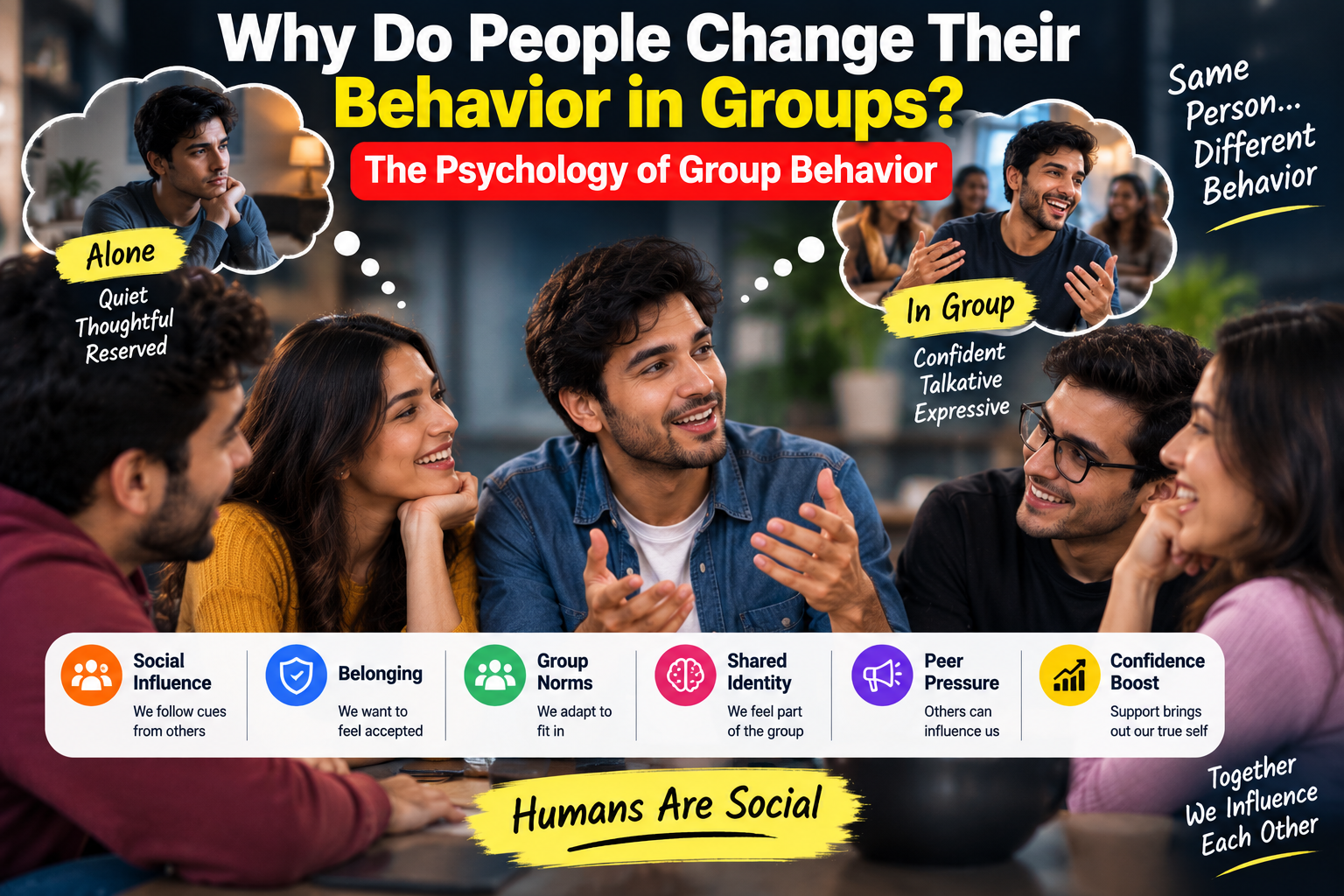
Have you ever noticed that you behave one way when you are alone and completely differently when you are surrounded by other people? Someone who is quiet by themselves might become extremely talkative with friends, while another person may agree with a group even when they originally had a different opinion.
This is a common part of everyday social life. People naturally pay attention to the behavior, reactions, expectations, and opinions of the people around them.
So, why do people change their behavior in groups? The answer involves social influence, conformity, group identity, shared expectations, social rewards, uncertainty, and the desire to feel connected to others.
Understanding the psychology of group behavior can help explain everything from conversations between friends to workplace meetings, classrooms, sports teams, online communities, and large crowds.
1. Humans Are Social by Nature
People spend a large part of their lives interacting with other people.
Families, friendships, workplaces, schools, communities, and online groups all create social environments in which people observe and respond to one another.
Because social interaction is such a regular part of life, people naturally become sensitive to the behavior of those around them.
When you enter a new group, you may quickly notice how people communicate, what topics they discuss, how they respond to disagreement, and what kinds of behavior seem accepted.
These observations can influence how you behave yourself.
2. Social Influence Can Change Behavior
Social influence refers broadly to the ways other people can affect our thoughts, feelings, decisions, and behavior.
Sometimes this influence is obvious. A friend might encourage you to try something new or a coworker might suggest a different way of completing a task.
Other times, influence is subtle.
You may notice that everyone in a group is speaking quietly, so you naturally lower your voice. Or you may notice that everyone is laughing and become more relaxed and expressive.
These small adjustments happen frequently during everyday social interaction.
3. People Often Look at Others for Social Cues
When people are uncertain about what to do, they may look at the behavior of others for clues.
Imagine entering an unfamiliar event where you do not know anyone. You might observe how other people are standing, where they are sitting, how loudly they are talking, and whether people are introducing themselves.
These observations provide information about what is happening in the environment.
This process can help people navigate unfamiliar social situations without having to consciously analyze every social rule.
4. Conformity Can Influence Group Behavior
Conformity describes situations in which people adjust their behavior, judgments, or expressed opinions to align more closely with a group or social expectation.
Conformity does not always involve pressure or coercion.
Sometimes people genuinely change their minds after hearing useful information from others. In other situations, they may simply adjust their behavior because they want to fit into the social environment.
For example, someone might adopt the communication style, dress habits, or routines commonly used within a particular group.
5. People Want to Feel Like They Belong
Belonging is an important part of social life.
When people feel accepted by a group, they may become more comfortable participating in conversations and activities.
This can influence behavior in subtle ways.
A person may learn the group’s humor, vocabulary, routines, or traditions. Over time, these shared patterns can become part of how the group communicates.
This does not necessarily mean that someone is pretending. Social groups naturally develop shared habits.
6. Group Identity Can Influence Behavior
People often identify with groups that are meaningful to them.
These groups might include families, friendship circles, professional teams, clubs, communities, sports teams, or online communities.
When group membership becomes an important part of someone’s identity, they may pay greater attention to the group’s values, traditions, and expectations.
This is one reason social identity can influence human behavior.
7. People Behave Differently Around Different Groups
You may already have experienced this yourself.
You might speak one way with family, another way with close friends, and differently again in a professional environment.
These changes do not necessarily mean that someone has multiple personalities.
Different environments have different expectations.
A workplace may encourage formal communication, while close friends may encourage jokes, informal language, and personal conversations.
The social environment can therefore bring different aspects of the same person’s behavior to the surface.
8. Peer Pressure Can Affect Decisions
Peer pressure is another form of social influence.
People may sometimes feel pressure to behave in ways that are common within their social group.
This can happen among teenagers and young adults, but social influence is not limited to a particular age.
Adults can also feel pressure to fit workplace expectations, social norms, professional cultures, or the behavior of their friends.
The strength of this influence can vary depending on the individual and the situation.
9. Groups Create Their Own Norms
Groups often develop informal rules about what is considered normal or appropriate.
These are sometimes called group norms.
For example, a group of friends might have an expectation that everyone responds quickly to messages. A workplace team might expect people to arrive on time for meetings.
These expectations may never be formally written down, yet group members can still recognize them.
Once people understand these norms, they may adjust their behavior accordingly.
10. The Presence of Other People Can Affect Performance
Simply knowing that other people are watching can sometimes change how someone performs.
Imagine giving a presentation to an empty room compared with giving the same presentation to a large audience.
The task is identical, but the social environment is completely different.
The presence of other people can increase attention, nervousness, motivation, or self-awareness depending on the person and situation.
This demonstrates how strongly context can influence social behavior.
11. People May Take More Risks in Groups
Group settings can sometimes change how people approach decisions involving risk.
When several people discuss an idea together, the final position of the group can differ from the opinions that individual members had at the beginning.
Several factors can contribute to this, including persuasive arguments, group norms, confidence in other members, and the desire to maintain agreement.
This is why decision making in groups can sometimes produce different outcomes from decisions made independently.
12. Responsibility Can Feel Different in a Group
People may experience responsibility differently when they are part of a group.
For example, imagine a large group of people watching a situation unfold. An individual might assume that someone else will respond first.
This can sometimes affect whether people take immediate action.
The important lesson is that individual behavior can be influenced by the number of people present and the expectations created by the situation.
13. Leadership Can Shape Group Behavior
Groups often respond to leadership, whether the leader is formally appointed or naturally influential.
A leader’s communication style can influence how group members approach tasks, solve problems, and communicate with one another.
Clear expectations can make a group more organized, while unclear communication can create uncertainty.
However, group behavior is rarely controlled by one person alone. Members also influence one another.
14. Emotions Can Spread Through Groups
Have you ever entered a room where everyone seemed excited and quickly started feeling more energetic yourself?
Emotions can influence social interactions.
People notice facial expressions, voices, gestures, and other emotional signals. These signals can affect how others respond.
A positive environment may encourage enthusiasm, while a tense environment may make people more cautious.
This does not mean emotions always spread in exactly the same way, but social environments can clearly influence emotional experiences.
15. People Sometimes Hide Their True Opinions
Group settings can create situations where people do not openly express what they really think.
Someone might disagree with an idea but remain silent because everyone else appears to support it.
Another person may avoid raising a concern because they do not want to create conflict.
This is one reason a group’s visible opinion does not always represent the private opinions of every member.
16. Online Groups Can Influence Behavior Too
Group behavior is not limited to physical environments.
Social media platforms, online forums, gaming communities, messaging groups, and other digital spaces can also create strong social environments.
People can observe what receives attention, approval, criticism, or disagreement and may adjust their behavior accordingly.
Online communication also has its own norms, language, humor, and expectations.
As a result, human behavior can change depending on whether someone is interacting face-to-face or through a digital community.
17. Why People Sometimes Agree With the Group
Agreement can have several possible explanations.
Someone may agree because they genuinely believe the group is correct. They may agree because other members have information they do not have. Or they may agree because maintaining social harmony feels important.
These different motivations can produce the same visible behavior: agreement.
That is why simply observing that someone followed the group does not tell us exactly why they did it.
18. Group Behavior Is Not Always Negative
Discussions about conformity and peer pressure sometimes focus entirely on their negative effects.
But social influence can also be useful.
Groups can help people learn new skills, adopt healthy routines, solve problems, share knowledge, and provide emotional support.
A person who joins a group focused on learning a skill may become more motivated because everyone around them is practicing regularly.
Positive group norms can therefore encourage constructive behavior.
19. Why Some People Resist Group Influence
Not everyone responds to group pressure in the same way.
Some people may strongly value independence and be comfortable expressing disagreement. Others may be more sensitive to social approval or group expectations.
Previous experiences, personality, confidence, the importance of the issue, and the strength of the group relationship can all affect how someone responds.
This is why group dynamics are complex rather than predictable from one simple rule.
20. How to Think More Clearly in Group Decisions
Understanding group influence can help people become more thoughtful when making decisions together.
- Share your own opinion first when appropriate. This can reduce the chance of simply adopting the first opinion you hear.
- Encourage respectful disagreement. Different perspectives can reveal information that the group might otherwise miss.
- Separate popularity from evidence. A widely supported idea is not automatically a correct one.
- Ask for independent views. Give people opportunities to express opinions without feeling pressured to agree.
- Consider the situation. Group behavior can change depending on the environment and the people involved.
Why Do People Change Their Behavior in Groups?
So, why do people change their behavior in groups?
There are many possible reasons. People naturally observe others for social cues, adapt to group norms, seek acceptance, respond to social influence, and sometimes change their behavior because of shared identities or expectations.
Groups can also provide information, support, motivation, and a sense of belonging.
At the same time, group influence can sometimes make people behave in ways they would not choose independently.
The effect depends heavily on the person, the group, and the situation.
Final Thoughts
The psychology of group behavior reveals how strongly our surroundings can influence everyday actions.
People are not isolated decision-makers. We constantly observe other people, interpret social signals, respond to expectations, and adjust our behavior to fit different environments.
That is why someone can be quiet in one group, highly confident in another, and completely different around close friends or family.
Understanding these patterns does not mean that every behavior is caused by social pressure. Individual personality and personal choices still matter.
But recognizing the influence of groups can help us understand ourselves and other people more clearly.
Related Reading
If you enjoy learning about human behavior and psychology, you may also like:
- Why Do People Mirror Each Other? The Psychology Behind Mirroring Behavior
- Why Do People Talk to Themselves? The Psychology Behind Self-Talk
- Why Do People Judge Others So Quickly? The Psychology Behind First Impressions
- Why Do People Become More Confident Around Friends? The Psychology of Social Comfort
- Why Do We Remember Some Things and Forget Others? The Psychology of Memory