Why Do We Overthink? The Psychology Behind Overthinking
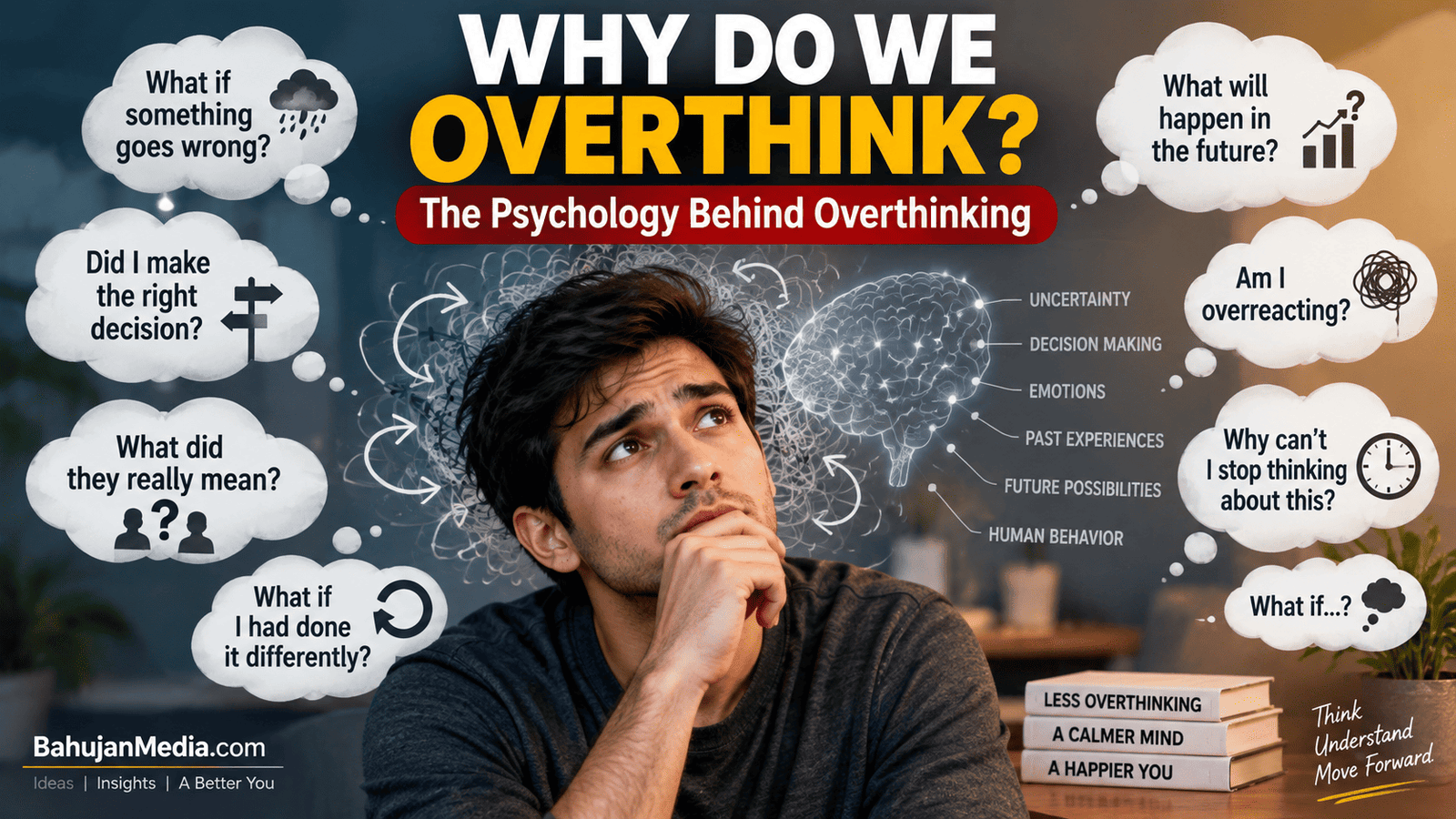
Why Do We Overthink?
Have you ever replayed the same conversation in your head, worried about a decision you already made, or imagined dozens of possible outcomes before taking action? If so, you may have experienced what people commonly call overthinking.
Why do we overthink when thinking is supposed to help us solve problems? The answer is not simply that some people “think too much.” Human thinking is designed to examine possibilities, remember experiences, predict what might happen next, and prepare for uncertainty. These abilities can be useful, but they can also become repetitive when the mind keeps returning to the same question without reaching a satisfying conclusion.
The psychology of overthinking involves several aspects of human behavior, including uncertainty, attention, memory, decision-making, emotions, and our natural tendency to look for explanations.
1. What Is Overthinking?
Overthinking generally refers to repetitive thinking about a situation, decision, problem, or possibility without making meaningful progress toward a solution.
Normal thinking helps us understand something and decide what to do. Overthinking can feel different because the same ideas keep returning. A person may repeatedly ask, “What if I had done something differently?” or “What if something goes wrong?” without obtaining new information.
It is important to remember that thinking carefully is not automatically overthinking. Considering different possibilities before an important decision can be useful. The problem is when repetitive thinking becomes difficult to stop or interferes with taking reasonable action.
2. Why Do We Overthink Uncertain Situations?
Uncertainty is one of the biggest reasons people overthink.
The human brain naturally tries to predict what might happen next. When the outcome of a situation is unclear, the mind may generate different possibilities and examine them repeatedly.
For example, imagine that you have sent an important message and have not received a reply. You might start considering several explanations. Perhaps the person is busy, perhaps they misunderstood the message, or perhaps they are upset.
Without new information, however, repeatedly examining the same possibilities cannot necessarily provide a definite answer.
This helps explain why uncertainty can create repetitive thinking: the mind wants an answer that the available information cannot provide yet.
3. Why Do People Overthink Decisions?
Decision-making can trigger overthinking because choices often involve uncertainty and potential consequences.
When a decision feels important, people may compare multiple options, imagine different outcomes, and think about what could happen if they choose incorrectly.
This can be helpful up to a point. Comparing information can improve a decision. But adding more and more hypothetical possibilities does not always make the decision better.
At some point, additional analysis may simply repeat information that has already been considered.
4. The Brain Tries to Predict the Future
One reason why we overthink is that the mind is constantly trying to anticipate what comes next.
Humans make predictions about everyday events all the time. We estimate how long a journey might take, anticipate how another person may respond, and consider what could happen after making a choice.
Prediction is useful because it allows us to prepare.
However, the future contains information that we do not yet have. When a person repeatedly tries to predict every possible outcome, the process can become endless.
Thinking about possible outcomes can therefore shift from useful preparation into repetitive mental simulation.
5. Why Does the Mind Replay Past Conversations?
Another common form of overthinking involves the past.
A person might replay a conversation and wonder whether they said the wrong thing, sounded rude, missed an opportunity, or should have responded differently.
Looking back at an experience can help people learn. For example, someone might realize that a particular communication approach did not work well and decide to communicate differently next time.
But repeatedly replaying the same conversation does not necessarily produce additional insight.
This is one reason why the psychology of overthinking is closely connected with memory and learning. The mind can revisit past information in an attempt to understand what happened, even when there is no new information to uncover.
6. Why Do We Overthink Small Details?
When something feels important, the mind may pay close attention to small details.
A person might analyze someone’s facial expression, the exact wording of a message, the timing of a response, or a minor mistake made during a conversation.
Paying attention to details can sometimes be valuable. However, a small detail may not contain enough information to explain an entire situation.
For example, a short reply could have many explanations. Without additional context, assigning one specific meaning to it can lead to unnecessary speculation.
7. How Does Fear of Making a Mistake Affect Thinking?
Fear of making the wrong choice can make decision-making more complicated.
If someone believes that every decision must be perfect, they may spend excessive time comparing options. They may search for additional information, imagine negative outcomes, and repeatedly reconsider choices they have already made.
This can create a cycle:
Decision → uncertainty → more analysis → temporary reassurance → new doubt → more analysis.
Understanding this pattern can help explain why people sometimes continue thinking about a decision even after they have enough information to act.
8. Why Can Negative Possibilities Feel So Important?
Human attention does not treat every possible event equally. Potential problems can attract significant attention because identifying a threat or mistake can be useful for survival and preparation.
This does not mean that people are naturally negative. Rather, situations involving possible problems can demand attention.
When someone repeatedly focuses on what could go wrong, however, their thoughts may become dominated by negative possibilities.
For example, instead of asking, “What are the possible outcomes?” a person may repeatedly focus on, “What is the worst thing that could happen?”
That shift can contribute to repetitive thinking.
9. What Is Rumination?
Rumination is a term used in psychology to describe repetitive thinking, particularly when someone repeatedly focuses on distressing experiences, problems, or negative thoughts.
Rumination is different from simply thinking carefully about a problem.
Useful reflection may lead to a lesson, decision, or next step. Rumination can keep returning to the same issue without producing a clear solution.
For example, reflecting on why an argument happened may help someone identify what they could do differently next time. Repeatedly asking the same questions without new information may instead keep the situation mentally active.
10. Why Does Overthinking Sometimes Feel Productive?
One interesting aspect of overthinking is that it can feel like problem-solving.
When a person is actively thinking about an issue, it may seem that they are making progress. The mind is busy, possibilities are being examined, and different explanations are being considered.
But mental activity and productive problem-solving are not always the same thing.
A useful question is: “Am I discovering something new or simply repeating the same thought?”
If new information, options, or insights are appearing, continued thinking may be useful. If the same ideas are repeating without changing the situation, the process may have become unproductive.
11. How Does Uncertainty Affect Human Behavior?
Uncertainty can influence many areas of human behavior.
People may seek additional information, ask others for opinions, delay decisions, or repeatedly check something when they are unsure about an outcome.
These behaviors can sometimes be useful. Gathering relevant information before making an important decision is sensible.
However, there is a difference between collecting useful information and repeatedly searching for complete certainty.
Many real-life decisions cannot provide 100 percent certainty. Learning to make reasonable decisions with incomplete information is therefore an important part of everyday decision-making.
12. Why Can Overthinking Make Decisions Harder?
Having many options does not always make a decision easier.
When people compare too many possibilities, they may become increasingly focused on the advantages and disadvantages of every option.
For simple decisions, this may not matter much. For important decisions, however, continuously adding new possibilities can make the choice feel increasingly complicated.
Instead of asking, “Which option is perfect?” it can sometimes be more useful to ask, “Which option meets the important requirements?”
This approach reduces the number of unnecessary comparisons and brings attention back to practical criteria.
13. Why Do We Think About Things We Cannot Control?
People naturally think about outcomes that matter to them, including situations they cannot fully control.
For example, someone may worry about how another person will react, whether an application will be accepted, or what will happen during an upcoming event.
Thinking about these possibilities can be understandable because the outcomes matter. But thinking cannot always control an external event.
Separating controllable and uncontrollable factors can therefore be useful.
For example, you may not control another person’s response, but you may control whether your own message is clear and respectful.
14. How Does Overthinking Affect Attention?
Repetitive thoughts can compete for attention with whatever a person is currently trying to do.
Imagine trying to read an article while repeatedly thinking about an unfinished conversation. Part of your attention may remain focused on the conversation even though your immediate task is reading.
This can make concentration more difficult.
The effect is especially noticeable when the thought feels emotionally important or unresolved.
Understanding this connection between attention and repetitive thinking can help explain why overthinking sometimes feels mentally exhausting.
15. Why Do We Overthink at Night?
Many people notice repetitive thinking when they are lying in bed at night.
During the day, attention is often divided among work, conversations, responsibilities, entertainment, and other activities. When the environment becomes quiet, thoughts that were pushed into the background may become more noticeable.
Nighttime also provides fewer external distractions.
This does not mean that everyone who thinks at night has a psychological problem. Sometimes the quiet environment simply gives the mind more opportunity to focus on unresolved questions.
16. Can Overthinking Be Connected to Perfectionism?
Perfectionism can sometimes contribute to repetitive thinking because a person may place very high standards on their decisions or performance.
If someone believes that a mistake is unacceptable, they may spend more time trying to eliminate every possible risk.
For example, a person preparing an important presentation might repeatedly edit the same sentence because they want every detail to be perfect.
Careful preparation can improve quality. But endlessly trying to remove every possible imperfection can consume time without producing a meaningful improvement.
17. Why Does Reassurance Sometimes Not End Overthinking?
People who are uncertain about something may ask others for reassurance.
Receiving an answer can provide temporary relief. However, if the underlying uncertainty remains, another question may appear later.
For example, someone might ask, “Do you think I handled that conversation correctly?” After receiving reassurance, they may later wonder whether the other person secretly interpreted the situation differently.
This illustrates an important feature of repetitive thinking: finding one answer does not always eliminate the desire for complete certainty.
18. Is Overthinking Always Bad?
No. Thinking deeply is not inherently harmful.
Careful analysis can help people solve problems, understand experiences, prepare for important situations, and make thoughtful decisions.
The difference is often found in the result.
Useful thinking tends to produce something practical: a decision, a plan, a new understanding, or a lesson. Repetitive thinking may continue without producing meaningful progress.
So the goal is not necessarily to stop thinking. It is to recognize when thinking is helping and when it has become repetitive.
19. How Can We Tell the Difference Between Thinking and Overthinking?
A simple way to examine your own thinking is to ask a few questions:
- Am I learning something new?
- Do I have new information to consider?
- Is there a practical action I can take?
- Am I solving the problem or repeatedly imagining possibilities?
- Has this thought already been considered several times?
- Am I searching for useful information or complete certainty?
These questions do not provide a medical diagnosis. They simply encourage awareness of how a thought process is functioning.
20. What Can Help When Thoughts Keep Repeating?
There is no single technique that works for everyone, but several practical approaches can help people create distance from repetitive thinking.
Writing down the problem can make it easier to separate facts from assumptions. Defining what is actually controllable can reduce unnecessary attention on things outside your influence. Setting a specific time to make a decision can also prevent endless comparison when enough information is already available.
Physical activity, social interaction, hobbies, and focused tasks can also shift attention away from repetitive thoughts.
If repetitive or distressing thoughts are significantly interfering with everyday life, sleep, work, or relationships, talking with a qualified mental health professional can provide personalized guidance.
21. How Does Understanding Overthinking Improve Decision-Making?
Understanding why we overthink can change how we approach decisions.
Instead of assuming that more thinking always produces a better answer, we can recognize when we already have enough relevant information.
A practical decision-making process might look like this:
- Define the actual decision.
- Identify the most important criteria.
- Gather relevant information.
- Compare realistic options.
- Choose a reasonable course of action.
- Accept that some uncertainty will remain.
This approach does not eliminate uncertainty. Instead, it recognizes that uncertainty is often part of real-life decisions.
22. What Does Overthinking Teach Us About Human Behavior?
Overthinking reveals something interesting about human behavior: our minds are constantly trying to understand the past and predict the future.
We look for patterns, explanations, causes, and possible outcomes. These abilities are extremely useful, but they do not always know when to stop.
This is why understanding our thinking patterns can be valuable. Instead of treating every thought as a fact or every possibility as a prediction, we can recognize thoughts as mental events that may or may not accurately describe reality.
This perspective can create more room for practical decision-making and focused action.
23. Why Do We Overthink? The Simple Explanation
So, why do we overthink?
People may overthink because the mind is trying to solve uncertainty, understand past events, predict future outcomes, avoid mistakes, make better decisions, or find explanations for situations that feel unresolved.
These are normal functions of human thinking. The difficulty begins when the process becomes repetitive and stops producing useful information or action.
In simple terms, overthinking can happen when the mind keeps searching for an answer even though the available information cannot provide a more certain one.
24. Final Thoughts
Overthinking is more complicated than simply “thinking too much.” The psychology of overthinking involves uncertainty, memory, attention, decision-making, emotions, prediction, and our natural desire to understand what is happening around us.
Thinking carefully can be useful. Reflecting on the past can teach valuable lessons, and considering future possibilities can help us prepare. But repetitive thinking without new information or meaningful action may not solve the problem it is trying to solve.
One useful habit is to ask yourself whether your current thinking is producing a new insight, a practical decision, or a clear next step. If it is not, it may be worth shifting your attention toward something you can actually control.
Understanding why people overthink is ultimately another way of understanding human behavior: the mind wants answers, but real life often contains uncertainty.
Related Reading
If you enjoy learning about psychology and human behavior, you may also like these articles: