Why Do Prices Go Up? Inflation Explained in Simple Terms
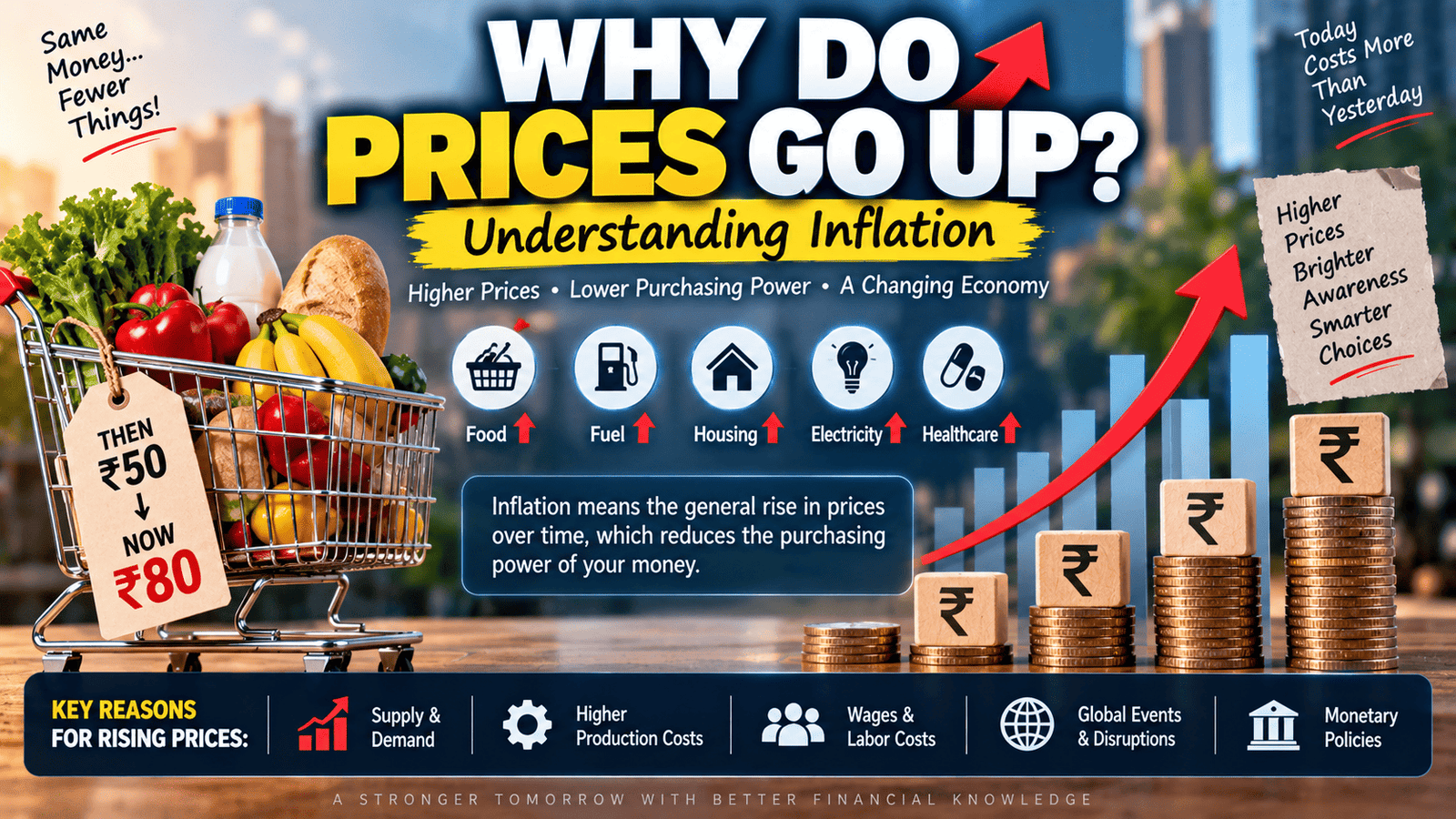
Have you ever noticed that something that cost ₹50 a few years ago may now cost ₹70, ₹80, or even more?
Prices of food, transportation, housing, services, electronics, and many other things can change over time. Sometimes a particular product becomes more expensive because of a temporary shortage. But when prices across a broad part of the economy rise over time, economists often describe the situation as inflation.
But why do prices go up in the first place?
The answer is not simply that businesses decide to charge more. Prices can be influenced by demand, supply, production costs, wages, energy prices, government policies, interest rates, global events, and many other factors.
Understanding inflation can make everyday financial decisions easier because it explains why the same amount of money may buy fewer goods and services over time.
1. What Is Inflation?
Inflation is a general increase in the prices of goods and services across an economy over time.
The important word is “general.” If the price of one product increases while everything else stays roughly the same, that does not necessarily mean the entire economy is experiencing inflation because of that product.
Inflation refers to a broader change in the overall price level.
When inflation occurs, the purchasing power of money generally decreases. In simple terms, the same amount of money may buy fewer goods and services than it did before.
2. Why Do Prices Go Up?
There is no single reason why prices increase.
Prices are influenced by the relationship between supply and demand, the cost of producing goods and services, consumer spending, wages, energy costs, transportation expenses, taxes, exchange rates, and many other economic factors.
For example, if a particular crop has a poor harvest, the supply of that food may decrease. If people still want roughly the same amount of food, the reduced supply can put upward pressure on prices.
On the other hand, if demand suddenly increases while businesses cannot increase production quickly enough, prices may also rise.
3. What Is Supply and Demand?
Supply refers to how much of a good or service is available, while demand refers to how much people want to buy.
When demand is strong and supply is limited, sellers may be able to charge higher prices.
When supply is abundant and demand is weak, businesses may have to reduce prices to attract buyers.
This basic relationship is one of the most important ideas for understanding why prices change.
However, real-world economies are much more complicated because many markets interact with one another.
4. What Is Demand-Pull Inflation?
Demand-pull inflation can occur when demand for goods and services grows faster than the economy’s ability to supply them.
Imagine a situation where consumers suddenly have more money available to spend and begin buying more products, while businesses do not have enough workers, materials, factories, or transportation capacity to increase production quickly.
When many buyers compete for a limited supply of products and services, businesses may raise prices.
This is one possible mechanism through which stronger demand can contribute to inflation.
5. What Is Cost-Push Inflation?
Cost-push inflation occurs when the cost of producing goods and services increases and businesses respond by raising prices.
Businesses have many expenses, including raw materials, electricity, fuel, transportation, equipment, rent, and labor.
If several important costs rise at the same time, businesses may find it difficult to maintain their previous prices.
For example, if energy and transportation costs increase significantly, producing and delivering many products can become more expensive.
Some businesses may absorb those costs, while others may pass part of the increase on to consumers through higher prices.
6. How Do Oil and Energy Prices Affect Other Prices?
Energy is an important input for many parts of the economy.
Fuel can affect transportation costs, while electricity and other forms of energy are used in manufacturing, agriculture, retail, offices, and many other activities.
If energy prices rise substantially, the increased costs can spread through supply chains.
A manufacturer may pay more to produce a product. A transportation company may pay more to move it. A retailer may then face higher costs before the product reaches the customer.
This does not mean every increase in energy prices automatically creates broad inflation, but energy costs can influence prices throughout an economy.
7. How Do Wages Affect Prices?
Wages are another important part of business costs.
If workers receive higher wages, businesses may face increased labor costs. Higher wages can also increase consumers’ purchasing power, which may influence demand.
However, higher wages do not automatically cause inflation.
If worker productivity increases at the same time, businesses may be able to produce more while paying higher wages. The relationship between wages, productivity, business costs, and prices is therefore more complicated than simply saying that higher salaries always create higher prices.
8. What Happens When Supply Falls?
Prices can rise when the supply of a product or service suddenly decreases.
Natural disasters, poor harvests, transportation problems, geopolitical events, factory shutdowns, or shortages of important materials can reduce supply.
If demand remains strong while supply falls, buyers may compete for the smaller quantity available.
This can push prices higher.
When the supply problem is temporary, the price increase may also be temporary. But if supply constraints continue or spread across many industries, the effect can become broader.
9. Why Did Prices Rise So Quickly During Some Global Disruptions?
Large disruptions can affect multiple parts of an economy at the same time.
Factories may face interruptions, transportation networks may experience delays, workers may become unavailable, and consumers may change their spending patterns.
If demand recovers faster than supply, certain products and services can become more expensive.
Because modern economies are connected through global supply chains, a problem in one region can sometimes affect businesses and consumers in other countries.
This is one reason major global disruptions can have economic effects far beyond the location where they originally occurred.
10. Does Printing More Money Cause Inflation?
Money supply can play a role in inflation, but the relationship is more complicated than the simple idea that “printing money always causes inflation.”
If the amount of money and spending power in an economy grows significantly while the supply of goods and services does not keep pace, stronger demand can put upward pressure on prices.
However, inflation is influenced by many factors, including economic conditions, production capacity, demand, expectations, interest rates, and supply disruptions.
Therefore, economists generally look at a broad set of factors rather than attributing inflation to one cause alone.
11. What Is Purchasing Power?
Purchasing power refers to how much goods and services a given amount of money can buy.
Suppose you have ₹1,000 today. If prices increase significantly over time, that same ₹1,000 may buy fewer products in the future.
This is one of the most important ways inflation affects everyday life.
Your bank balance may still show the same numerical amount, but the amount of goods and services that money can purchase can change.
12. Why Does Inflation Make the Cost of Living Feel Higher?
The cost of living is influenced by the prices people pay for everyday necessities and services.
If food, transportation, housing, healthcare, education, utilities, and other important expenses become more expensive, households may need more money to maintain the same lifestyle.
This is why people often notice inflation through their everyday spending rather than through economic statistics.
If several household expenses rise at the same time, the change can become particularly noticeable.
13. Why Don’t All Prices Rise at the Same Rate?
Inflation does not mean that every product becomes more expensive by exactly the same percentage.
Different goods and services have different supply chains, production costs, levels of competition, and demand patterns.
For example, the price of vegetables may be strongly influenced by weather and harvest conditions, while the price of an electronic product may depend more heavily on components, manufacturing costs, technology, exchange rates, and global supply chains.
As a result, some prices may rise quickly, some may rise slowly, and some may even fall while the overall price level is increasing.
14. What Is the Inflation Rate?
The inflation rate measures how quickly the general price level is changing over a particular period.
Governments and statistical agencies typically use price indexes to track changes in the cost of a selected basket of goods and services.
If the index is higher than it was during the comparison period, the data may indicate that prices have increased.
The exact method used to calculate inflation varies by country and by the specific price measure being used.
15. What Is the Consumer Price Index?
The Consumer Price Index, commonly called the CPI, is one widely used measure of changes in consumer prices.
It tracks the prices of a basket of goods and services that represents household consumption.
The basket can include categories such as food, housing, transportation, clothing, healthcare, education, communication, recreation, and other expenses.
The exact categories and weights differ between countries because spending patterns differ across economies.
16. Why Can Your Personal Inflation Feel Different From the Official Rate?
The inflation rate reported for an entire economy is based on an average basket of goods and services.
Your personal spending pattern may be very different from that average.
For example, someone who spends a large portion of their income on fuel may notice energy-price increases more strongly than someone who rarely travels.
Similarly, a household that spends heavily on rent may experience changes in housing costs differently from someone who owns their home.
This is why the official inflation rate and your personal experience of rising prices may not always feel identical.
17. Is Inflation Always Bad?
Inflation is often discussed negatively because rapid price increases can reduce purchasing power and make financial planning more difficult.
However, a small and relatively stable rate of inflation can exist in a growing economy and is not necessarily considered harmful by itself.
Central banks generally aim to maintain price stability rather than trying to make prices fall continuously.
The bigger concern is often unusually high, unpredictable, or persistent inflation because it can make it harder for households and businesses to plan.
18. What Is Deflation?
Deflation is a broad decline in the general price level.
At first, falling prices might sound positive because consumers can potentially buy goods and services for less.
However, persistent deflation can create economic problems.
If people expect prices to continue falling, they may delay purchases. Businesses can then face weaker demand, lower revenues, and pressure on profits and wages.
Therefore, falling prices across the economy are not automatically a sign of a healthy economy.
19. What Is Hyperinflation?
Hyperinflation refers to an extremely rapid and uncontrolled increase in prices.
During severe hyperinflation, money can lose purchasing power very quickly.
People may find that prices change dramatically over short periods, making normal economic planning extremely difficult.
Hyperinflation is very different from the moderate inflation rates that many economies experience during ordinary periods.
20. How Do Central Banks Try to Control Inflation?
Central banks can use monetary policy to influence economic activity and inflation.
One important tool is the setting of policy interest rates.
Higher interest rates can make borrowing more expensive and can encourage saving, potentially reducing demand in the economy.
Lower interest rates can have the opposite effect by making borrowing more attractive and supporting spending and investment.
Central banks use these and other tools while considering economic growth, employment, inflation expectations, financial conditions, and other factors.
21. Why Can Higher Interest Rates Slow Inflation?
When interest rates rise, loans and other forms of borrowing can become more expensive.
Consumers may postpone some purchases, while businesses may reconsider certain investments.
Reduced demand can help ease pressure on prices when demand is a major contributor to inflation.
However, monetary policy does not instantly solve supply shortages or other causes of price increases.
Its effects can also take time to move through the economy.
22. How Does Inflation Affect Savings?
Inflation can reduce the purchasing power of money that remains unchanged over time.
Imagine keeping ₹100 in cash for many years while prices steadily rise. The number on the note remains ₹100, but the amount of goods and services that ₹100 can buy may decrease.
This is why people often consider not only the numerical return on their savings but also how that return compares with inflation.
The important concept is the difference between a nominal amount and its purchasing power.
23. How Does Inflation Affect Long-Term Financial Planning?
Inflation matters when people plan for future expenses.
For example, someone saving for education, a home, retirement, or another long-term goal may need to consider that future prices could be higher than today’s prices.
A financial goal of ₹10 lakh today may require a larger amount in the future if the cost of the goods and services involved rises over time.
This is why long-term financial planning often considers inflation rather than assuming today’s prices will remain unchanged forever.
24. Why Do People Say Money Loses Value Over Time?
When people say that money loses value over time, they usually mean that its purchasing power declines.
The ₹500 note itself does not physically become worth less. Its face value remains ₹500.
What changes is what you can buy with that ₹500.
If the prices of goods and services rise, the same amount of money can purchase a smaller quantity of those goods and services.
This is one of the simplest ways to understand the effect of inflation on money.
25. How Can You Understand Inflation in Simple Terms?
Imagine that a basket of everyday goods costs ₹1,000 today.
After several years, the same basket costs ₹1,200.
You still have ₹1,000, but that ₹1,000 is no longer enough to buy the same basket.
The money has not physically disappeared. Instead, the purchasing power of that money has decreased because the prices of the goods increased.
That is the basic idea behind inflation.
Final Thoughts
So, why do prices go up?
There is rarely one simple answer. Prices can rise because demand increases, supply falls, production becomes more expensive, energy costs change, wages and productivity change, global events disrupt supply chains, or monetary and economic conditions change.
Inflation is essentially a broad increase in the general price level over time, and one of its most important effects is a reduction in the purchasing power of money.
Understanding inflation can help you make sense of everyday changes in food prices, transportation costs, housing expenses, savings, and long-term financial goals.
The next time you notice that something costs more than it used to, remember that there may be several economic forces working behind that price tag.
If you enjoy learning about everyday topics through simple explanations, you can also explore our article on strange but true facts about the world.