15 Strange but True Facts About the World That Sound Made Up
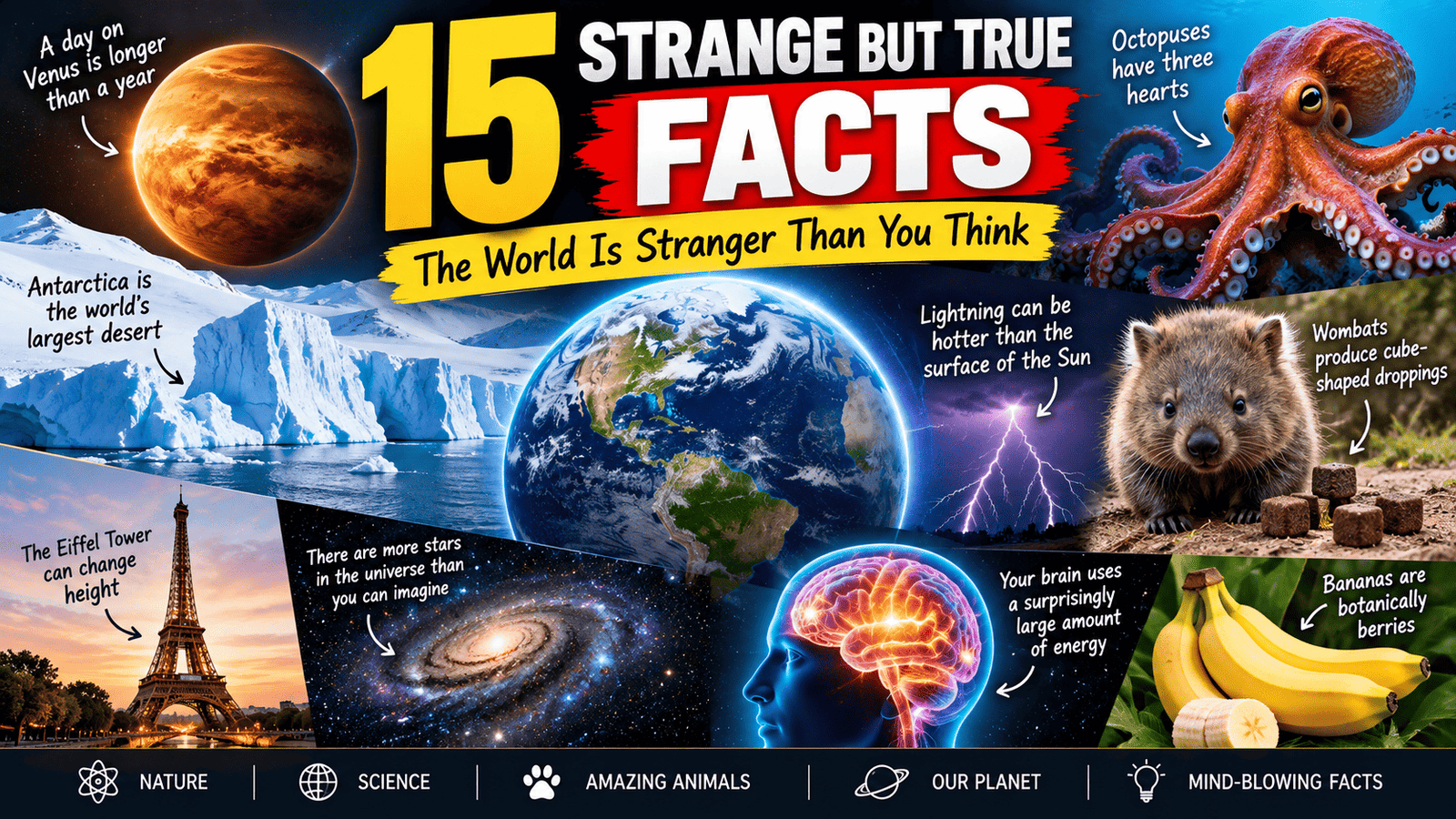
Some of the most fascinating facts about our world sound almost impossible when you hear them for the first time. From unusual animals and strange planetary behavior to surprising facts about nature and history, the world is full of things that challenge our expectations.
Here are 15 strange but true facts that show just how unusual our planet and the universe around it can be.
1. A Day on Venus Is Longer Than a Year
Venus has one of the strangest time systems in our solar system. The planet takes about 243 Earth days to rotate once on its axis, while it takes about 225 Earth days to complete one trip around the Sun.
That means a single rotation of Venus takes longer than its entire year.
Venus also rotates in the opposite direction from most planets, meaning the Sun would appear to rise in the west and set in the east. It is a fascinating example of how different another planet can be from Earth.
2. Octopuses Have Three Hearts
Octopuses are among the most unusual animals on Earth, and their circulatory system is one reason why.
An octopus has three hearts. Two hearts help move blood toward the gills, while the third heart pumps oxygen-rich blood to the rest of the body.
Even more interestingly, an octopus has blue blood because its blood uses a copper-based protein called hemocyanin to transport oxygen. This is one of the many adaptations that help octopuses survive in the ocean.
3. Antarctica Is the World’s Largest Desert
When people hear the word desert, they usually imagine a place covered in sand. But a desert is actually defined primarily by how little precipitation it receives.
Antarctica receives very little precipitation in many areas, which makes the entire continent technically a desert.
It is therefore both the coldest continent on Earth and the world’s largest desert. Its enormous ice-covered landscape can make this fact seem surprising, but deserts do not have to be hot.
4. Bananas Are Botanically Berries
In everyday language, we usually think of berries as small, colorful fruits such as strawberries, blueberries, or raspberries.
Botanically, however, the definition is different. Bananas meet the botanical criteria for being classified as berries.
Strawberries, despite having the word “berry” in their name, do not technically qualify as true botanical berries.
This is a great example of how scientific classifications can be very different from the way we commonly use words.
5. Honey Can Last for an Extremely Long Time
Honey has several natural properties that make it unusually resistant to spoilage. Its low water content, acidity, and chemical composition create an environment that is difficult for many microorganisms to survive in.
Archaeologists have even discovered ancient honey in Egyptian tombs that was still preserved after thousands of years.
That does not mean every jar of honey will remain perfect forever. Storage conditions, contamination, and processing can affect its quality. But properly stored honey is remarkably durable compared with many other foods.
6. Wombats Produce Cube-Shaped Droppings
Wombats are small Australian mammals with one of the strangest biological features in the animal kingdom.
Their droppings are cube-shaped.
Unlike an artificial object made into a cube, the shape develops inside the wombat’s digestive system because different areas of its intestine have different levels of elasticity.
Scientists believe the unusual shape may help wombats leave scent-marking piles that are less likely to roll away.
7. Lightning Can Be Hotter Than the Surface of the Sun
A lightning strike may last only a fraction of a second, but the air inside a lightning channel can reach temperatures of roughly 30,000 kelvin.
That is several times hotter than the visible surface of the Sun.
The extreme heating causes the surrounding air to expand rapidly, producing the shock wave that we hear as thunder.
So the next time you see lightning during a storm, remember that an incredibly hot electrical discharge has just passed through the atmosphere.
8. Sharks Are Older Than Trees
Sharks have existed on Earth for hundreds of millions of years.
The earliest shark-like animals appeared long before many of the trees we recognize today evolved.
This means sharks belong to an ancient lineage that survived enormous changes in Earth’s climate, oceans, ecosystems, and geography.
Modern sharks are therefore part of a very old evolutionary story that stretches far deeper into Earth’s history than most people realize.
9. The Eiffel Tower Can Change Height
The Eiffel Tower is made primarily of iron, and like many materials, iron expands when heated and contracts when cooled.
During hot weather, the tower can become slightly taller because of thermal expansion. During colder conditions, it becomes slightly shorter.
The difference is not something visitors can normally notice by simply looking at the tower, but it demonstrates an important principle of physics that affects structures and objects around us every day.
10. Water Can Exist in More Than One Form at the Same Time
Water is commonly associated with three states: solid, liquid, and gas.
Under the right conditions of temperature and pressure, water can behave in ways that are very different from what we experience in everyday life.
One particularly interesting situation is the triple point, where solid, liquid, and gaseous water can coexist under specific conditions.
This unusual state is important in physics because it provides a precise reference point for understanding temperature and phase changes.
11. Your Brain Uses a Surprisingly Large Amount of Energy
The human brain represents only a small portion of total body weight, yet it requires a significant amount of energy to keep working.
Even when you are resting, your brain is constantly using energy to maintain electrical activity, communicate between cells, process information, and control essential functions.
Thinking, remembering, learning, and even maintaining basic awareness all depend on an enormous amount of biological activity happening inside the brain.
12. There Are More Stars in the Universe Than You Can Easily Imagine
The night sky may appear to contain thousands of stars, but the visible stars are only a tiny fraction of what exists in the universe.
Our Milky Way galaxy alone contains an enormous number of stars, and astronomers have observed countless other galaxies.
Because the observable universe contains vast numbers of galaxies, the total number of stars is difficult to comprehend on an everyday scale.
Looking at the night sky is therefore like seeing only a tiny window into something vastly larger.
13. Some Animals Can Regrow Lost Body Parts
Regeneration is one of the most fascinating abilities found in nature.
Some animals can regenerate damaged or lost body structures. For example, certain species of salamanders can regrow limbs, while some other animals can regenerate parts of their bodies in different ways.
Humans also have limited regenerative abilities, but they are nowhere near as extensive as those of certain animals.
Scientists study these natural abilities because understanding how regeneration works could potentially provide valuable insights into biology and medicine.
14. Earth Is Not a Perfect Sphere
Earth may look like a perfect sphere in photographs, but its shape is slightly different.
Because Earth rotates, its equatorial region bulges outward slightly while the polar regions are somewhat flattened.
The scientific description of Earth’s overall shape is more complicated than simply calling it a sphere. Scientists use terms such as an oblate spheroid when describing this general shape.
So even the planet beneath our feet is not quite as geometrically perfect as it appears from space.
15. The Universe Is Still Full of Mysteries
Perhaps the strangest fact of all is that scientists still do not have answers to many of the biggest questions about the universe.
We know that the universe contains galaxies, stars, planets, black holes, and many other fascinating objects. However, major questions remain about dark matter, dark energy, the earliest moments of the universe, and whether life exists elsewhere.
Modern telescopes and space missions continue to reveal new information, but every discovery can also create new questions.
Why These Facts Are So Fascinating
What makes strange facts interesting is not simply that they are unusual. Many of them reveal something deeper about how nature works.
A day being longer than a year on Venus teaches us that planetary systems can behave very differently from Earth. The three hearts of an octopus show how evolution can produce specialized biological systems. Antarctica being a desert demonstrates why scientific definitions can differ from everyday language.
These examples remind us that our everyday experience represents only a small part of what is possible in nature.
Final Thoughts
The world is filled with strange, surprising, and fascinating facts. Some are found in the deepest oceans, some in the human body, some in distant planets, and others in ordinary objects that we see every day.
The more we learn about science, nature, history, and the universe, the more we discover that reality is often stranger than fiction.
And the best part is that there are still countless facts waiting to be discovered.