Why Do We Procrastinate? The Psychology Behind Putting Things Off
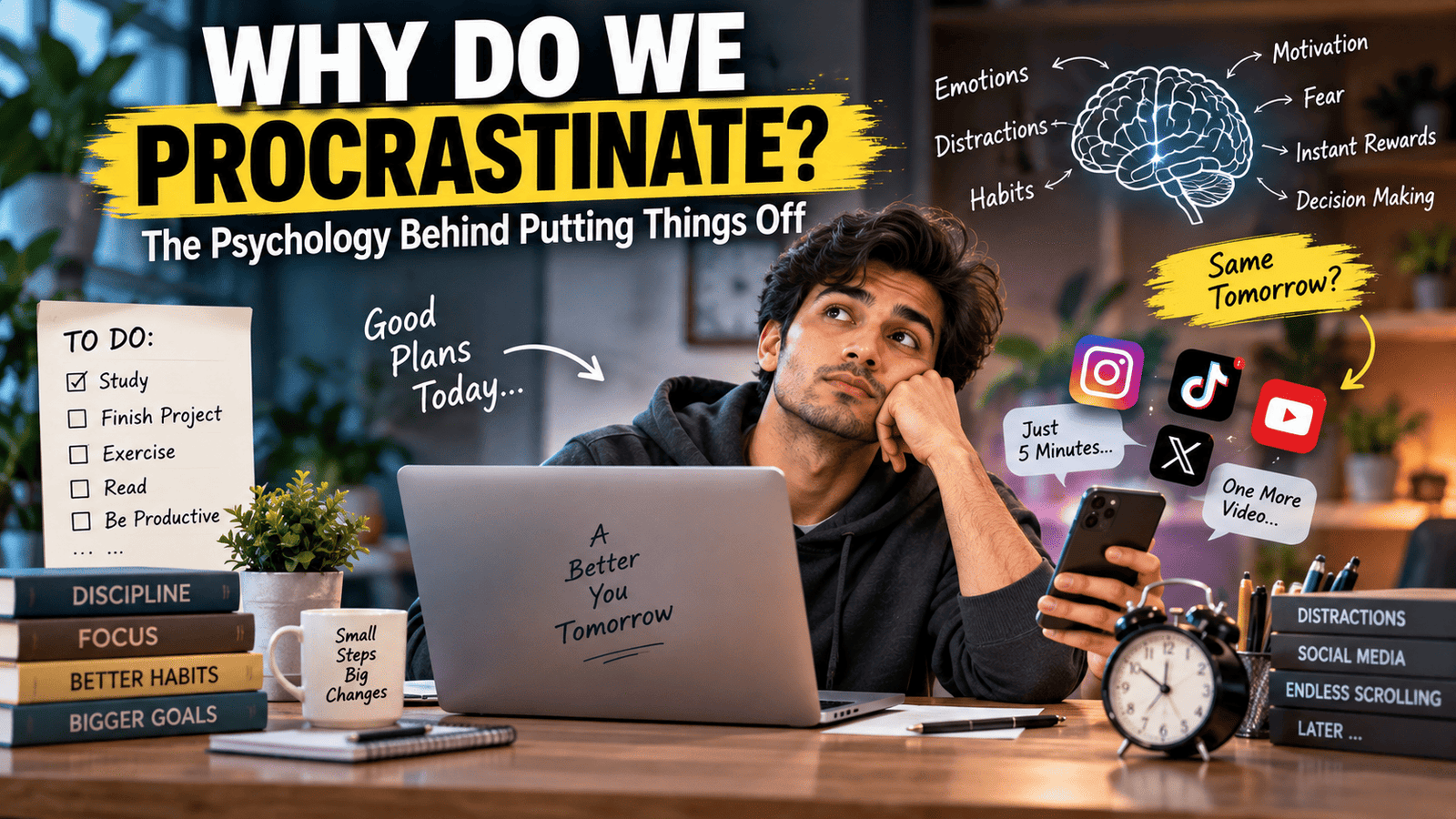
Why Do We Procrastinate? The Psychology Behind Putting Things Off
Have you ever had an important task to complete, knew exactly what needed to be done, and still found yourself doing something else?
Maybe you planned to start studying, but checked your phone first. You wanted to finish an important work project, but suddenly cleaning your desk seemed much more interesting. You promised yourself that you would exercise in the evening, but when the time arrived, you decided to start tomorrow.
This behavior is known as procrastination.
Procrastination is more complicated than simply being lazy. People often delay tasks even when they understand that postponing them may create problems later.
So why do we procrastinate?
The psychology behind procrastination involves motivation, emotions, decision-making, habits, attention, and the way people respond to difficult or uncomfortable situations.
Understanding these factors can help explain why putting things off is such a common part of human behavior.
1. What Is Procrastination?
Procrastination is the act of unnecessarily delaying or postponing a task despite knowing that completing it may be beneficial.
It can happen with almost anything:
- Studying for an exam
- Completing work assignments
- Paying bills
- Exercising
- Cleaning the house
- Starting a personal project
- Making an important decision
- Responding to messages or emails
The important part is that procrastination usually involves a conflict between what we intend to do and what we actually do.
A person may genuinely want to complete a task but still choose another activity in the moment.
This is one reason procrastination is interesting from a psychological perspective.
2. Why Do We Procrastinate?
One major reason people procrastinate is that some tasks create uncomfortable feelings.
A task might feel:
- Difficult
- Boring
- Confusing
- Stressful
- Overwhelming
- Uncertain
- Frustrating
When a person thinks about starting such a task, they may experience discomfort.
Doing something easier or more enjoyable can provide temporary relief.
For example, imagine that someone needs to prepare a complicated report.
Instead of starting immediately, they watch a few videos or scroll through social media.
The entertainment provides an immediate positive experience, while the difficult report is pushed into the future.
The person has not solved the problem, but they have temporarily avoided the uncomfortable feeling associated with it.
3. Procrastination Is Not Always About Laziness
One of the biggest misunderstandings about procrastination is that everyone who procrastinates is lazy.
That is not necessarily true.
A person can be hardworking and responsible while still procrastinating on certain tasks.
Someone might complete ten different responsibilities during the day but repeatedly avoid one particular task.
The reason may be that the avoided task feels especially difficult, uncertain, boring, or emotionally uncomfortable.
This is why understanding procrastination requires looking beyond simple ideas about laziness.
Human behavior is influenced by many different factors.
4. Immediate Rewards Can Be More Attractive
Another important part of the psychology of procrastination is the difference between immediate and future rewards.
Imagine you have two choices.
You can spend an hour working on an important project that may benefit you next month.
Or you can spend that hour watching entertaining videos that make you feel good right now.
The future benefit may be much more valuable, but the immediate reward is easier to experience.
People often pay strong attention to what feels rewarding in the present moment.
This can make activities such as entertainment, social media, games, or casual browsing very tempting when compared with tasks whose benefits will appear later.
This does not mean people cannot think about the future.
It simply means that immediate experiences can strongly influence decisions.
5. Difficult Tasks Can Feel Bigger Before We Start
Have you ever delayed a task for several days and then discovered that completing it did not take nearly as long as you expected?
This is common.
Before starting something unfamiliar or difficult, people may imagine the entire challenge at once.
A large assignment can therefore feel overwhelming.
Instead of thinking:
“I only need to write the first paragraph.”
the mind may focus on:
“I have to finish this entire project.”
That difference can change how a task feels.
Breaking a large task into smaller steps can make the starting point feel less demanding.
For example, instead of thinking about completing an entire article, someone might simply decide to spend ten minutes researching the first section.
Starting can sometimes be easier when the task is psychologically smaller.
6. Fear of Making Mistakes Can Encourage Procrastination
Sometimes people delay tasks because they are worried about the outcome.
A person may think:
“What if I do it badly?”
“What if people criticize my work?”
“What if I make the wrong decision?”
“What if it isn’t good enough?”
These thoughts can make starting uncomfortable.
When the possible outcome feels threatening to confidence or self-image, postponing the task can become an easy short-term escape.
This is one reason perfectionism and procrastination can sometimes appear together.
A person may want to produce excellent work, but the pressure to perform perfectly can make it harder to begin.
The result can be a frustrating cycle:
High expectations lead to anxiety.
Anxiety leads to avoidance.
Avoidance reduces progress.
Reduced progress creates more pressure.
More pressure makes the task feel even harder.
7. Motivation Can Change From Day to Day
Many people assume that they need to feel motivated before they can begin working.
In reality, motivation is not always stable.
It can change depending on:
- Sleep
- Stress
- Environment
- Mood
- Energy levels
- Interest in the task
- Recent experiences
- Other responsibilities
If someone waits for the perfect level of motivation, they may keep delaying the task.
Sometimes action comes before motivation.
For example, a person may not feel particularly motivated to exercise.
They put on their shoes anyway and start walking.
After beginning, the activity may feel easier than expected.
This is one reason starting with a small action can be useful.
8. Habits Can Make Procrastination Automatic
Procrastination can become a habit.
Imagine someone who regularly responds to difficult tasks by opening social media.
The pattern may eventually become automatic.
Task appears.
Discomfort appears.
Phone comes out.
Attention moves somewhere else.
Temporary relief follows.
If this pattern happens repeatedly, the behavior can become easier to repeat.
The person may not consciously decide each time to procrastinate.
Instead, the brain may become accustomed to the familiar sequence.
Changing the environment can sometimes help interrupt this pattern.
For example, keeping distracting apps away from the immediate work environment can reduce the number of opportunities to automatically switch activities.
9. Why Starting Can Be the Hardest Part
One interesting feature of procrastination is that the anticipation of a task can sometimes feel worse than the task itself.
Before beginning, there may be uncertainty.
Once a person starts, the situation becomes more concrete.
The first few minutes can reveal that the task is manageable.
This is why the “just start” approach can sometimes be helpful.
It does not require finishing the entire task immediately.
The goal is simply to reduce the psychological barrier between thinking about the task and taking the first action.
For example:
Open the document.
Write one sentence.
Read one page.
Put on your shoes.
Answer one email.
These actions may appear small, but they can change the relationship between intention and action.
10. Procrastination Can Affect Decision-Making Too
Procrastination is not limited to physical tasks.
People can also postpone decisions.
Choosing a career path, responding to an important message, comparing options, or making a financial decision can all become reasons for delay.
Sometimes people postpone decisions because there are too many choices.
When every option has advantages and disadvantages, deciding can feel uncomfortable.
The person may continue researching without ever making a decision.
Information can be useful, but endless searching can become another form of avoidance.
At some point, a person may need to accept that uncertainty is part of decision-making.
11. The Environment Can Influence Procrastination
People often think procrastination is entirely about willpower.
But the environment matters too.
A workspace filled with distractions can make concentration harder.
A phone next to you provides an easy alternative whenever a task becomes uncomfortable.
Notifications can interrupt attention.
An unclear schedule can make it difficult to decide what should happen next.
Changing the environment can therefore make certain behaviors easier or harder.
For example, someone trying to focus might:
- Turn off unnecessary notifications
- Put the phone farther away
- Prepare materials before starting
- Work in a quieter location
- Divide large projects into smaller tasks
- Set a specific starting time
These changes do not eliminate procrastination completely, but they can reduce unnecessary friction.
12. How People Can Understand Their Own Procrastination
There is no single reason why everyone procrastinates.
One person may delay because a task is boring.
Another may delay because it feels overwhelming.
Someone else may avoid a task because they are worried about making a mistake.
Understanding the personal trigger can be more useful than simply telling yourself to “stop procrastinating.”
A simple question can help:
“What am I trying to avoid feeling right now?”
The answer might be boredom, confusion, uncertainty, frustration, fear, or something else.
Once the trigger becomes clearer, it may be easier to choose a practical response.
For example, if the task feels overwhelming, break it down.
If it feels confusing, clarify the first step.
If distractions are the problem, change the environment.
If fear of mistakes is holding you back, focus on producing a first draft rather than a perfect final result.
Final Thoughts
So, why do we procrastinate?
There is no single answer.
Procrastination can be influenced by emotions, immediate rewards, difficult tasks, uncertainty, habits, distractions, motivation, and the way people perceive future consequences.
Most importantly, procrastination is a common example of how human behavior can be different from our intentions.
We can know what we should do and still struggle to begin.
Understanding that conflict can help us become more observant of our own behavior.
Instead of simply labeling ourselves as lazy, it can be more useful to ask what is making the task difficult to start.
Sometimes the solution is to make the task smaller.
Sometimes it is to remove distractions.
Sometimes it is to accept that the first attempt does not need to be perfect.
And sometimes the most useful step is simply to begin with one small action.
The psychology of procrastination reminds us that behavior is rarely as simple as it looks from the outside.
Our decisions are influenced by what we feel, what we expect, what we notice, and what rewards are available in the present moment.
Understanding those patterns can help us make better choices and become more aware of how our minds influence our everyday behavior.