Why Do People Mirror Each Other? The Psychology Behind Mirroring Behavior
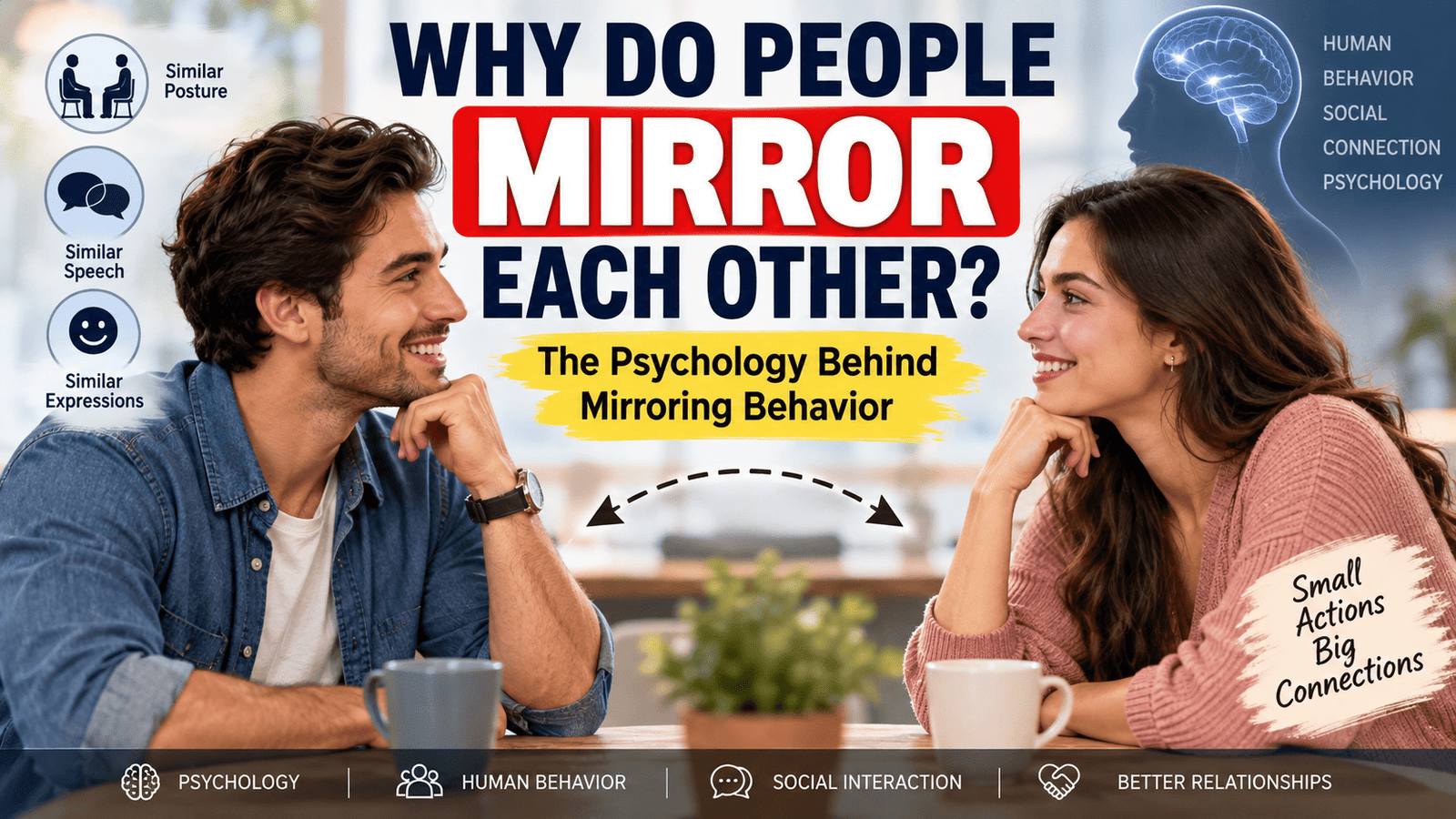
Why Do People Mirror Each Other? The Psychology Behind Mirroring Behavior
Have you ever noticed that two people who are having a good conversation sometimes start sitting in similar positions, using similar gestures, or even speaking in similar ways?
One person crosses their arms, and a short while later the other person does something similar. Someone starts speaking more slowly, and the other person’s speaking pace gradually changes too.
This behavior is often called mirroring.
Mirroring behavior is a common part of human social interaction. It can happen consciously, but in many situations, people may imitate small behaviors without realizing they are doing it.
Psychologists and researchers have studied imitation, social learning, nonverbal behavior, and interpersonal coordination for decades. While mirroring does not automatically reveal what someone is thinking or feeling, it can help us understand how people adapt to one another during social interactions.
Here are some interesting things to know about the psychology of mirroring behavior.
1. What Is Mirroring Behavior?
Mirroring behavior happens when one person’s actions, expressions, posture, speech patterns, or other behaviors become similar to another person’s behavior.
The similarity can involve many things, including:
- Body posture
- Hand gestures
- Facial expressions
- Speaking speed
- Tone of voice
- Word choices
- Physical movements
- Expressions of emotion
Mirroring does not always mean that someone is deliberately copying another person.
In many everyday conversations, these similarities can develop naturally as people respond to each other’s behavior.
For example, if two friends are having an energetic conversation, both may begin using larger hand gestures and speaking more enthusiastically.
The behavior can develop gradually without either person intentionally deciding to imitate the other.
2. Mirroring Can Happen Without Conscious Awareness
One of the most interesting aspects of mirroring behavior is that people may not always notice that they are doing it.
Human beings constantly observe the people around them. During conversations, we pay attention to facial expressions, body movements, tone, pauses, and other social signals.
Because much of this happens automatically, people can sometimes reproduce aspects of another person’s behavior without consciously planning to do so.
This is one reason everyday conversations can contain many subtle similarities between the people involved.
However, unconscious does not mean universal. Not everyone mirrors everyone else, and the amount of mirroring can vary depending on the people and situation.
3. People Learn by Observing Others
Mirroring is connected to a much broader feature of human behavior: social learning.
From childhood, people learn many behaviors by watching other people.
Children observe parents, teachers, siblings, friends, and other people around them. They can learn communication patterns, social behaviors, routines, and skills partly through observation and imitation.
Adults also continue learning from other people.
For example, someone entering a new workplace may gradually learn how meetings are conducted, how colleagues communicate, and which behaviors are considered appropriate.
This doesn’t necessarily mean they are consciously copying everyone around them.
Instead, people often adapt their behavior based on what they observe in their social environment.
4. Mirroring Can Be Part of Social Connection
People generally pay attention to signals that indicate whether an interaction is going smoothly.
When two people naturally coordinate their behavior, the interaction can sometimes feel more comfortable or connected.
For example, two people who are having an engaging conversation may gradually develop similar speaking rhythms or body movements.
This kind of behavioral coordination is sometimes described as interpersonal synchrony or behavioral matching.
It is important not to overinterpret it, though.
Seeing someone copy a gesture does not prove that they like you, agree with you, or want to become closer to you.
Human behavior is influenced by many factors, including personality, culture, environment, attention, and the specific situation.
5. Why Do People Copy the Way Others Speak?
Mirroring is not limited to body language.
People can also adapt aspects of their speech during conversations.
They may change:
- Speaking speed
- Volume
- Vocabulary
- Sentence structure
- Accent features
- Conversational rhythm
This can happen because people naturally adjust their communication style depending on who they are talking to.
For example, someone speaking with a young child may use simpler language and a slower pace than they would use during a professional meeting.
Similarly, friends may develop shared expressions or phrases after spending a lot of time together.
Language adaptation is therefore another example of how social environments can influence human behavior.
6. Emotional Expressions Can Also Be Mirrored
Have you ever smiled because someone else smiled?
Facial expressions can influence social interactions, and people often respond to the emotional expressions they observe in others.
If someone looks excited, the people around them may become more expressive as well.
If someone speaks calmly during a stressful situation, their calm behavior may influence the tone of the interaction.
This does not mean emotions are automatically transferred from one person to another.
Instead, social signals can provide information that helps people understand what is happening and decide how to respond.
Our brains are constantly processing these signals during social interactions.
7. Mirroring Is Not the Same as Manipulation
You may have seen claims online suggesting that mirroring is a secret technique that can make anyone like you.
That idea is much too simplistic.
Mirroring can occur naturally, but deliberately copying every movement someone makes can easily feel strange or unnatural.
Effective communication is not simply about imitating another person’s posture or gestures.
Good social interaction involves listening, responding appropriately, respecting boundaries, and paying attention to context.
Trying to force mirroring into every conversation can actually make an interaction less comfortable.
Natural behavioral coordination is very different from mechanically copying another person.
8. Culture Can Influence Social Behavior
Human behavior is strongly influenced by culture.
Gestures, eye contact, personal space, facial expressions, and conversational styles can have different meanings in different societies.
A behavior that seems normal in one cultural environment may be unusual in another.
This is important when interpreting body language.
For example, someone who uses fewer gestures may not necessarily be uninterested or unfriendly. Their communication style may simply be different.
That is why mirroring should always be interpreted within the broader social and cultural context.
9. Mirroring Does Not Reveal Someone’s Thoughts With Certainty
This is one of the most important things to remember.
There is no universal rule saying:
“They crossed their arms, so they are defensive.”
Or:
“They copied my gesture, so they definitely like me.”
Human behavior is rarely that simple.
A person might cross their arms because they are cold, comfortable, tired, or simply sitting that way.
Similarly, someone might copy another person’s movement because it is convenient, because they noticed it, or because the two people naturally coordinate their behavior.
Individual behaviors usually have multiple possible explanations.
The best way to understand someone’s behavior is to consider patterns, context, and direct communication rather than relying on one isolated gesture.
10. Mirroring Can Help Us Understand Human Connection
The fascinating part about mirroring is not that it provides a secret code for reading people’s minds.
Its real value is that it shows how strongly human behavior is connected to social environments.
People constantly observe one another.
They adjust their language, expressions, movements, and communication styles based on what is happening around them.
This ability helps people participate in conversations, learn social norms, coordinate activities, and build relationships.
In that sense, mirroring is one small example of a much bigger psychological process: humans are highly social learners.
How Mirroring Connects With Everyday Psychology
Mirroring is just one part of the fascinating world of human behavior.
Our attention, expectations, emotions, memory, and social environment can all influence how we behave.
For example, the way we notice information can affect what we remember. The social environment around us can also change how we communicate and respond to other people.
If you enjoyed learning about these patterns, you may also enjoy our article about 10 psychology facts that explain why people behave the way they do.
Final Thoughts
Mirroring behavior is a fascinating example of how people influence one another during everyday interactions.
People may naturally adopt similar gestures, expressions, speech patterns, or behaviors when communicating with others.
Sometimes this happens consciously, but often it can happen without deliberate planning.
However, mirroring should not be treated as a guaranteed method for reading someone’s feelings or intentions.
Human behavior is complicated.
The same gesture can have different meanings in different situations, and understanding people requires looking at the bigger picture.
The more we learn about mirroring, social learning, and communication, the more we can appreciate how complex everyday human interactions really are.